
Sustainability for Device Production
This call closed on 30th June 2026.
The theme for this call is ‘sustainability for device production’. The sustainable creation of digital devices relies on minimising environmental impact during the design and production processes, as well as sourcing components responsibly and designing for minimal impact during device operation and at end-of-life. In addition to efficient use of resources and minimal environmental impact, device creation should also support social and economic responsibility across the entire product lifecycle.
We are seeking project proposals relating to more sustainable digital device prototyping, iterative innovation and low-volume production. This encompasses concepts such as modular design, repairability, responsible material selection, energy-efficient production processes, ethical supply chains, and circular economy strategies. The focus of this call is on the sustainable production of digital devices, rather than devices created for sustainability purposes that might not have been made in a sustainable way.
| Sustainability for Device Production | |
|---|---|
| Total fund | £150,000 |
| Maximum award | £50,000 |
| Opening date | Thursday 19th May |
| Closing date | Tuesday 30th June midnight BST |
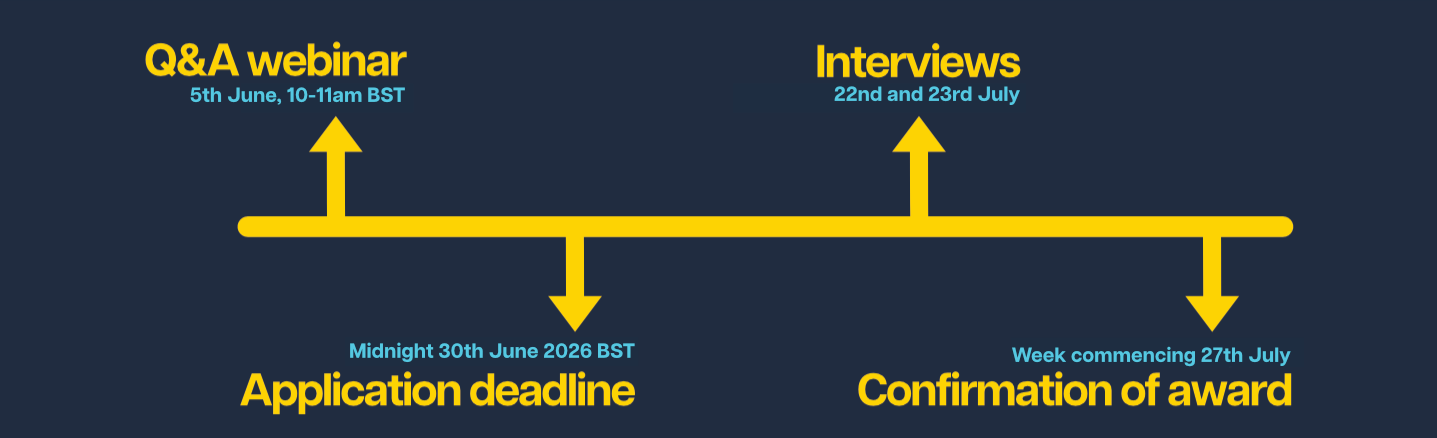
Funding timeline
Guidance for Applicants
|
Q&A webinar |
5th June, 10-11am BST |
|
Application Deadline |
Midnight 30th June 2026 BST |
|
Interviews |
22nd and 23rd July |
|
Confirmation of awards |
Week commencing 27th July |
|
Project start |
September 2026 |
|
Project finish |
May 2027 |
Each project is expected to start in September 2026 and finish by the end of May 2027. The total funding for this call is £187,500 (100% full economic cost), of which £150,000 (80% full economic cost) will be funded by pro². The maximum amount available for each project is £50,000 (representing 80% full economic cost). All costs should be inclusive of VAT and/or any other applicable tax. The terms and conditions for UKRI funding apply, and can be found here. Applicants must demonstrate in the application form how the funding will be spent.
Proposals should be costed and approved by the applicant’s organisation before submission. In addition, please ensure that the terms of the sub-award agreement are accepted by the applicant’s organisation prior to submission. A copy of the sub-award agreement can be found here.
Each project must include at least one Principal Investigator (PI) and one Project Partner. The project team can also include staff (e.g. project managers, co-investigators, project administrators etc.). Please note, industry-based project partners are not eligible to receive funding and in fact, we encourage them to top-up the funding available where possible. A letter of support from your project partner should be sent alongside your application form. Eligibility for the roles listed above are in line with EPSRC rules, which can be found here.
Applications for funding will be assessed via an application form which you can download here and a short interview. Applications will be anonymised and sent to an independent review panel for ranking before being shortlisted for interview by the pro² Network Steering Group. The criteria used in the assessment process is as follows:
• Applicability to the theme of the funding call.
• Realistic and achievable objectives and workplan.
• Evidence of project co-creation with collaborative partners must be clear in the application.
• Adequate consideration of EDI (Equity, Diversity and Inclusivity). Bringing together individuals from different backgrounds and with different personal circumstances brings a wider range of experience, leading to improved decision-making, innovation and problem solving. We would like to see how EDI has been considered in the project from recruitment through to project outputs.
• Novelty.
• Likely impact of the work and potential for wider engagement.
Project PIs will ultimately be responsible for ensuring that projects are carried out within the agreed timescales and budget. Where the day-to-day management of the project is carried out by another project team member, they can be assigned as a point of contact for the work.
All applicants must work with our Research Designer from the beginning of their projects. The Research Designer will work with you to find innovative ways to visualise your work and communicate it to a diverse audience. We’re keen to utilise interesting and accessible ways to communicate the outputs from your work, therefore we will be exploring the most appropriate way to do this and asking for your ideas in the application form. The Research Designer will work with you to create the agreed format for reporting your funding outcomes.
The pro² team are keen to stay up to date with your progress on the project and so, we will be arranging a site visit at the mid-point and end-point of the work. This is not intended to interfere with the work, but to find out how it is going and offer advice/guidance where useful.
All intellectual property (IP) belongs to the party that generated it, however grantees must ensure that IP is freely available and used for the benefit of society. Please see the sub-award agreement for more detail on intellectual property arrangements.
If you have any questions about the funding or application criteria, please contact Sarah Hughes or Maura Lydon at admin@prosquared.org.
pro² handles all personal data in accordance with current U.K. data protection legislation and the EU General Data Protection Regulation (GDPR) where appropriate.

Your questions answered
Following our funding call webinar on the 5th of June, here are the answers to all the questions our participants asked.
Glossary

Digital device
A physical piece of equipment that contains a computer or microcontroller. Today, myriad devices are digital including smartphones, tablets and smartwatches (PC Mag).

Isotype
An ‘equal’ copy of a prototype. It is likely that a prototype will need to go through one or more steps of refinement to (a) allow it to be replicated more easily, so that isotypes can be produced, and (b) to ensure it is suitably robust and performant that it’s useful to make isotypes, e.g. for technical testing or user evaluation. Isotypes are, however, unlikely to be sufficiently refined to qualify as a products. [NB Isotype already has meanings in the specific contexts of biology, crystallography, immunology and picture language, Collins Dictionary].

Platforming
A solid technological foundation upon which products can be created, incorporating open access to the necessary knowledge, standards, tools, capabilities and facilities [NB Platforming already has meanings in the specific contexts of petroleum refinery (Collins Dictionary) or video gaming (Wiktionary)].
Producer
An individual or organisation taking a leadership role in the creation of a product, inclusive of the prototype to product phases [NB Producer already has meanings in the specific contexts of entertainment production (films, music etc) and industry, Cambridge Dictionary].

Product
something that is made to be sold, usually something that is produced by an industrial process (Cambridge Dictionary). Products must provide sufficient utility to justify the cost of production and operation, must comply with local laws and regulations, and may become relied-upon by their users, requiring practical and cost-effective ways of supporting their on-going use.

Prototype
the first example of something, such as a machine or other industrial product, from which all later forms are developed (Cambridge Dictionary).